
NZ Asbestos Management Plan: Essential 2026 Compliance Guide for Your Business

Who Needs an Asbestos Management Plan in NZ? (2026 Guide)
Key Takeaways
- All PCBUs managing workplaces where asbestos is identified or likely must maintain a written management plan.
- Buildings constructed or refurbished before 1 January 2000 carry a high probability of containing asbestos.
- The Asbestos Management Plan (AMP) requires a formal review at least every five years or following significant site changes.
- Compliance involves a site-specific asbestos register, risk assessments, and clear emergency procedures.
- Independent consultancy ensures your plan remains conflict-free and focused solely on safety and legal obligations.
Managing a commercial property or a business in New Zealand involves a significant amount of paperwork, but few documents are as critical as the Asbestos Management Plan (AMP). Under the Health and Safety at Work (Asbestos) Regulations 2016, the responsibility for identifying and managing asbestos falls squarely on the shoulders of those who manage or control the workplace. Whether you are a commercial landlord in Napier or a project manager in Gisborne, understanding your legal obligations is the first step toward ensuring site safety.
Asbestos remains the leading cause of work-related fatalities in New Zealand. Current data indicates that asbestos exposure causes approximately 220 deaths each year, with roughly 1,000 new diagnoses of asbestos-related diseases annually. These figures highlight why WorkSafe maintains a strict stance on compliance and why a "set and forget" approach to safety documentation is no longer acceptable in 2026.
Defining the PCBU: Who Carries the Legal Duty?
The Health and Safety at Work Act uses the term PCBU, which stands for a Person Conducting a Business or Undertaking. This definition is broad. It includes limited liability companies, sole traders, local councils, schools, and charities. If you have management or control of a workplace where asbestos is present, or even likely to be present, the law requires you to have a written AMP in place.
Consider a commercial building owner in Hastings who leases space to three different retail tenants. In this scenario, the landlord and each tenant business are all PCBUs. They share overlapping duties. They must work together to ensure the asbestos risks are managed and that the AMP is accessible to anyone who might disturb the building fabric, such as a plumber or an electrician. You can read more about the specific asbestos management plans Hawke’s Bay businesses need to stay compliant.
Private homeowners generally fall outside the PCBU definition while they are simply living in their homes. However, the moment a homeowner engages a contractor to perform work, the home becomes a workplace. For landlords of residential rental properties, the obligations are clear. You are a PCBU in respect to that rental property and must manage asbestos risks to protect both your tenants and any tradespeople entering the premises.
The Pre-2000 Rule
New Zealand's history with asbestos-containing materials (ACMs) dictates our current regulations. While the importation of raw asbestos ended earlier, stockpiles of materials were used in construction well into the late 1990s. Consequently, WorkSafe regulations focus heavily on buildings constructed or refurbished before 1 January 2000. If your building predates this cutoff, the law assumes asbestos is likely present until a competent person proves otherwise through a survey.
A compliant AMP starts with a thorough inspection. We recommend beginning with a professional assessment to identify the location and condition of any ACMs. You can find more detail on how these inspections work in our guide to asbestos surveys explained.
What Must Your Asbestos Management Plan Contain?
An AMP is a living document that guides daily operations. It is the central repository for all information regarding asbestos on your site. According to the Health and Safety at Work (Asbestos) Regulations 2016, your plan must include several specific components to be legally compliant.
The foundation of the plan is the asbestos register. This is a detailed list of all identified or presumed asbestos, noting its location, type (such as friable or non-friable), and current condition. Beyond the register, the plan must outline your management decisions. For example, if you decide to leave a section of asbestos-backed vinyl in place, the plan must state how you will monitor it and what controls are in place to prevent disturbance.
Your document must also include procedures for recording incidents or emergencies, such as an accidental breakage of an asbestos cement sheet. It should clearly define roles and responsibilities, ensuring that everyone from the building manager to the visiting contractor knows their duty. Finally, it must include a timetable for managing the risks, which may include scheduled removals or regular re-inspections. We provide a deeper look at these requirements in our article on creating and maintaining a compliant asbestos management plan.
The Five-Year Review and Re-inspections
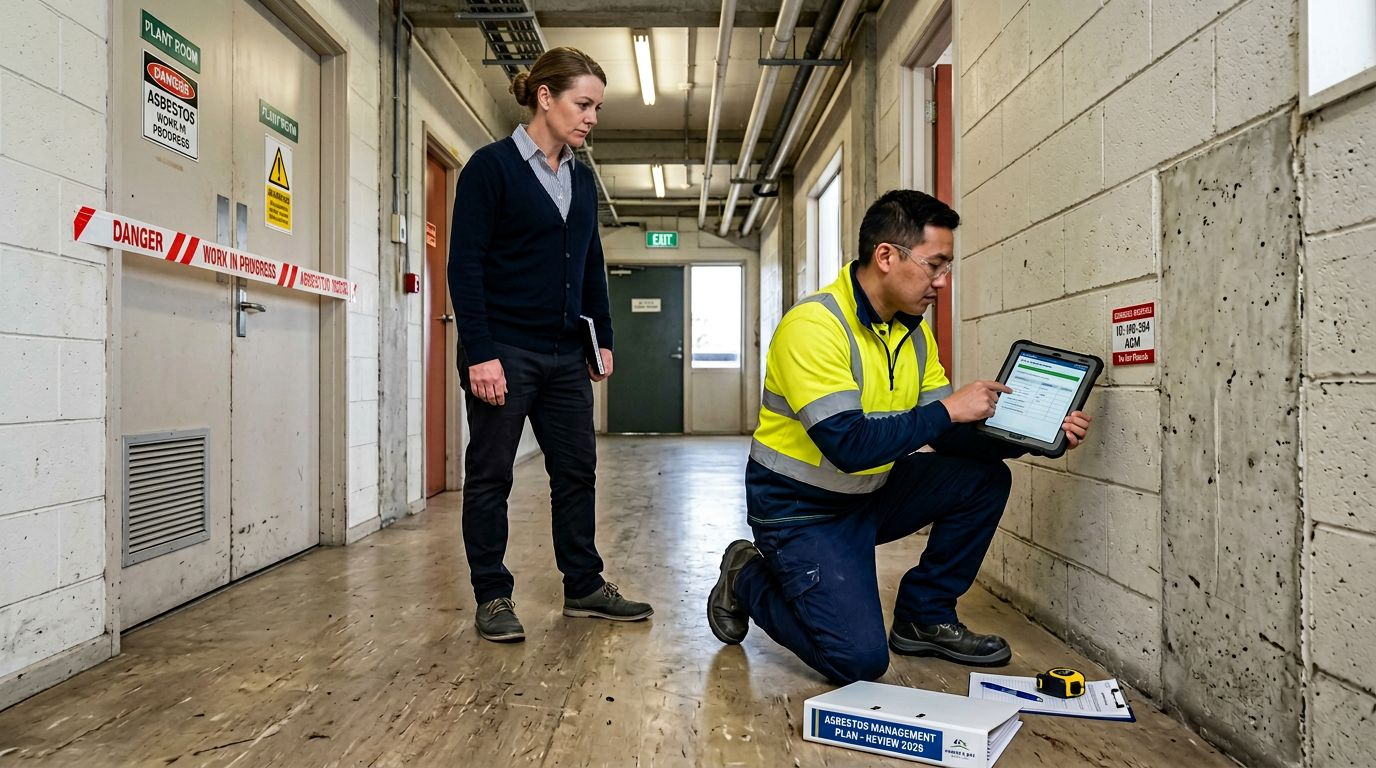
Compliance is an ongoing process rather than a one-time task. The law requires a formal review of the AMP at least every five years. However, several triggers require an earlier review. You must update the plan if asbestos is removed, disturbed, or if new ACMs are discovered. If a health and safety representative requests a review or if the current control measures are found to be ineffective, the document must be updated immediately.
Regular re-inspections are the most effective way to keep your register accurate. An asbestos-containing material that was in "good" condition three years ago may have degraded due to weathering or accidental damage. By scheduling regular checks, you ensure your risk assessments remain valid and your PCBU duties are met.
Risks of Non-Compliance
The consequences of failing to manage asbestos are severe. Beyond the tragic health implications for workers and tenants, the legal and commercial risks are significant. WorkSafe has the authority to issue infringement notices, shut down sites, and pursue prosecutions that result in heavy fines. For instance, a farmer in Timaru recently faced substantial penalties for the unsafe demolition of a building containing asbestos.
Commercial projects often face lengthy delays and budget blowouts when asbestos is discovered unexpectedly. A robust AMP identifies these risks early, allowing for planned removals rather than emergency stoppages. It protects your reputation and ensures your business continues to operate without avoidable interruptions.
Practical Pathway for Hawke’s Bay and Gisborne
For businesses in Napier, Hastings, or the wider East Coast, the path to compliance is straightforward. We suggest starting with a consultation to determine the scope of your building's needs. From there, a management survey will produce the necessary register. This register then informs the creation of your AMP and your ongoing re-inspection schedule.
Transparency in pricing helps businesses plan their compliance budgets effectively. In the current market, an asbestos management survey starts from $299 + GST, while re-inspection surveys also begin at $299 + GST. These costs vary based on the size and complexity of the building, but they represent a minor investment compared to the potential fines for non-compliance.
The Importance of Independent Advice
We believe that safety advice should be free from conflicts of interest. Some removal companies offer to write management plans, but this creates a situation where the person identifying the problem also profits from the solution. WorkSafe guidance highlights the value of independence between the assessor and the removalist.
Asbestos Safe Consultancy remains 100% independent. We do not perform removal work. Our focus is entirely on providing accurate testing, clear reports, and compliant management plans. This independence ensures that our recommendations are based solely on your safety and legal requirements. If you need to secure your site's compliance or update an aging plan, contact our team in Napier and Hastings today for expert, local advice.