
Asbestos Regulations 2016: Your Essential Guide to Property Owner Compliance
Health and Safety at Work (Asbestos) Regulations 2016: Key Points for Property Owners
Key Takeaways
- All workplaces built before 2000 are presumed to contain asbestos until a survey proves otherwise.
- PCBUs must maintain a written Asbestos Management Plan if asbestos is identified or likely to be present.
- Licensed removal is mandatory for all friable asbestos and any non-friable amounts exceeding 10 square metres.
- Independent clearance certificates are a legal requirement before re-occupying a site after licensed removal.
- Failing to obtain a clearance certificate can result in fines up to $50,000 for businesses.
Asbestos remains the leading work-related killer in New Zealand, contributing to approximately 220 deaths every year from preventable diseases. While the era of using asbestos in new builds has passed, the legacy of its use remains embedded in our infrastructure. The Health and Safety at Work (Asbestos) Regulations 2016 exist to manage this risk, placing clear, non-negotiable duties on those who own or manage property.
We see many property owners across Hawke’s Bay and Gisborne who feel overwhelmed by the technical language of these regulations. Our role is to provide the independent, plain-English guidance you need to protect your people and ensure your business remains compliant with New Zealand law.
Who the Law Applies To: Understanding the PCBU
The regulations focus on the "Person Conducting a Business or Undertaking," or PCBU. In the context of property, this generally means the business or organisation in control of a workplace. This definition includes commercial landlords, tenants, local councils, schools, and body corporates. In many cases, multiple PCBUs share duties for the same site. For example, a commercial landlord in Napier and their retail tenant both have responsibilities to manage any asbestos present in the building.
Residential owner-occupiers generally sit outside the scope of these regulations until they engage contractors to perform work. Once a builder or plumber enters a home, that home becomes a workplace, and the contractor has duties to manage the risks they encounter. For landlords of residential rentals, the lines are more specific, particularly when common areas or shared maintenance are involved.
You can find more detail on how these roles interact in our Asbestos Management FAQs.
The Duty to Identify Asbestos in Pre-2000 Buildings
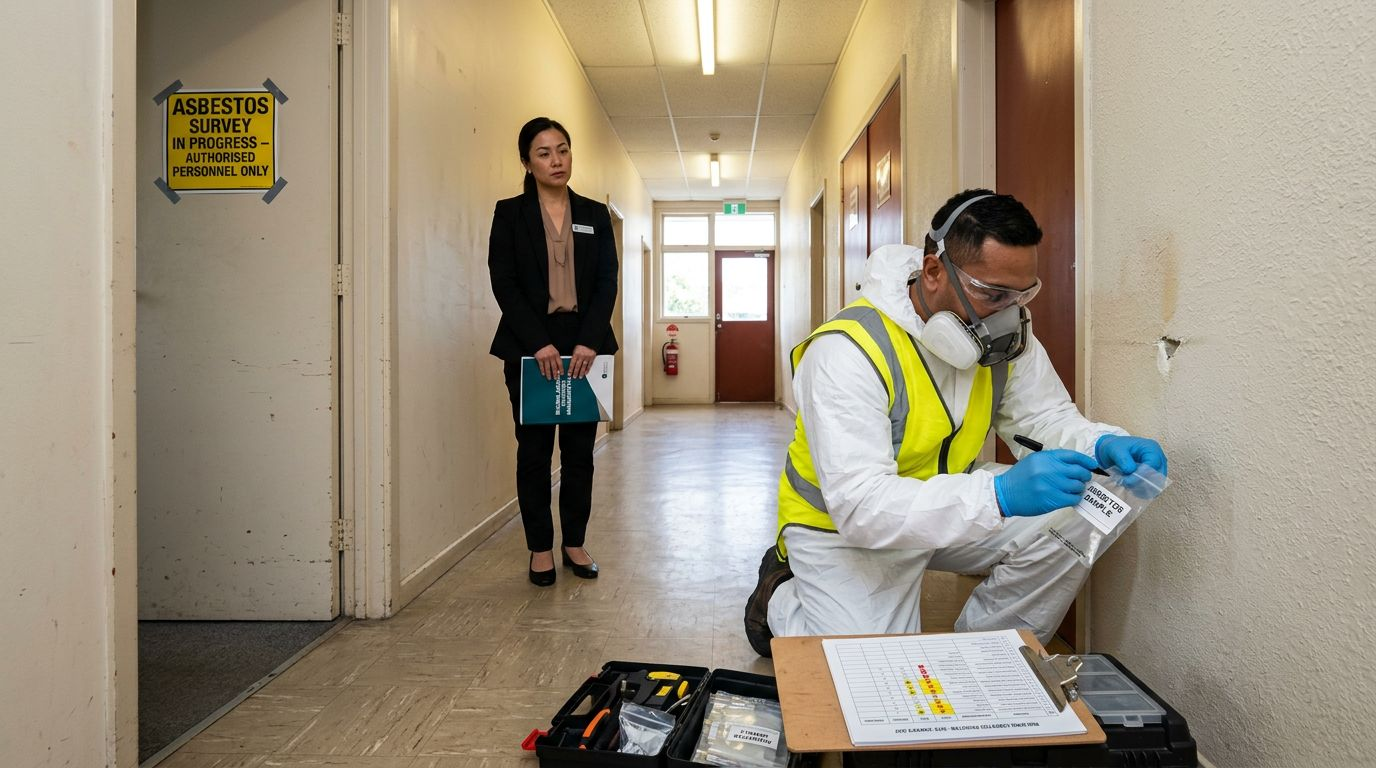
The 2016 Regulations mandate that PCBUs with management or control of a workplace must ensure asbestos is identified if they know, or ought reasonably to know, that a risk exists. New Zealand buildings constructed or refurbished before 1 January 2000 carry a high probability of containing asbestos. The law assumes asbestos is present in these structures until a competent person proves otherwise through a survey and laboratory analysis.
Asbestos has been identified in over 3,000 different building materials used in New Zealand. These include texture coatings, pipe lagging, insulation, wall panels, cladding, and floor coverings. Identifying these materials requires a professional survey. Once identified, the location and condition of the materials must be recorded in an asbestos register, which serves as the foundation for your safety strategy.
Asbestos Management Plans: A Legal Requirement
A written Asbestos Management Plan (AMP) is a legal requirement for any workplace where asbestos is identified or is likely to be present. This document outlines how you will manage the risks associated with the material on your site. A compliant plan includes the asbestos register, risk assessments, control measures, and clear procedures for emergencies or accidental disturbances.
The regulations require you to review this plan at least every five years. You must also update the plan if asbestos is removed, disturbed, or if new materials are discovered. For a commercial property manager in Hastings, keeping this plan accessible on-site ensures that any tradespeople or staff are aware of the risks before they start work. We provide comprehensive support for developing these plans, as detailed in our guide on the Asbestos Management Plan NZ.
Licensed Removal and the Class A and B Structure
The 2016 Regulations introduced a strict licensing regime for asbestos removal. Any friable asbestos, which is material that can be crumbled by hand pressure, must be removed by a Class A licensed removalist. For non-friable materials, such as fibre-cement roofing or cladding, a license is required if the area exceeds 10 square metres. Class B licenses are restricted to non-friable removal only, while Class A holders can handle both types.
Property owners must verify that their chosen contractor holds the correct license for the specific task. This ensures the work is performed under controlled conditions, using specialised equipment and safety protocols to prevent the release of dangerous fibres into the air.
Air Monitoring and Fibre Thresholds
Air monitoring provides the data needed to verify that safety controls are working during removal and that an area is safe to re-occupy. For Class A removal and high-risk projects, monitoring is a mandatory requirement. This process involves using specialised pumps and filters to capture air samples, which are then analysed in a laboratory.
The regulations set specific fibre limits that dictate site safety. During removal work, the "stop work" level is 0.02 fibres per millilitre (fibres/ml). If samples reach this level, the removalist must immediately cease operations and investigate the cause. To pass a final clearance and allow people back into the area, the air monitoring must show levels at or below 0.01 fibres/ml.
Clearance Certificates and the Independence Rule
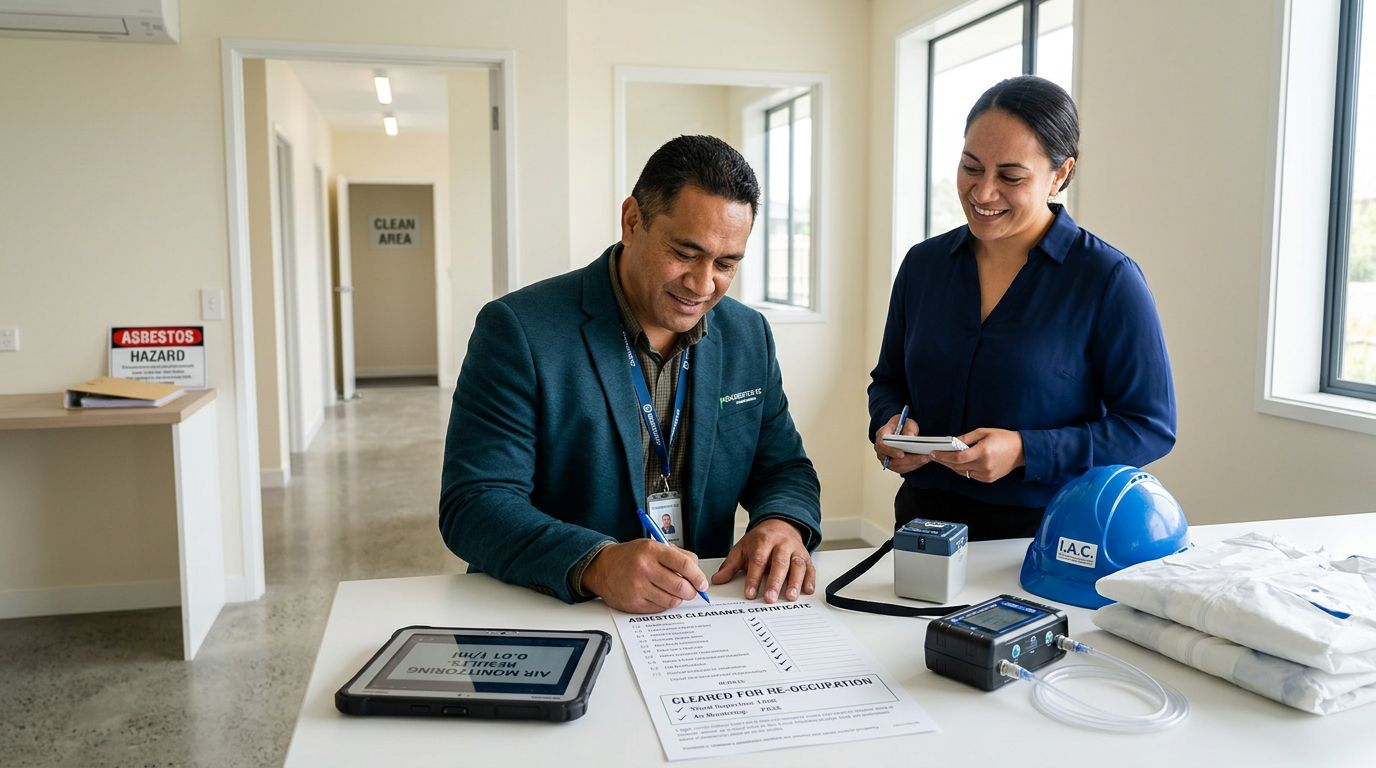
Regulation 42 states that a PCBU must obtain a written asbestos clearance certificate before re-occupying an area where licensed removal has occurred. This certificate is the final step in a four-stage process: a documentation review, a detailed visual inspection, air monitoring where required, and a final assessment of the site’s cleanliness.
Crucially, the person issuing the clearance certificate must be independent of the removal contractor. This independence ensures there is no conflict of interest and that the inspection is truly objective. Skipping this step is a serious breach of the law, with fines up to $10,000 for individuals and $50,000 for businesses. You can read more about the asbestos clearance certificate process and its legal necessity on our dedicated service page.
The Import Ban on Asbestos-Containing Products
While the use of raw asbestos was banned in New Zealand in 1984, the importation of products containing asbestos remained legal for much longer. The Imports and Exports (Asbestos-containing Products) Prohibition Order 2016 finally closed this gap on 1 October 2016. This order makes it illegal to import any product containing asbestos unless a specific permit is granted by the Environmental Protection Authority for very narrow circumstances, such as research.
This ban prevents new asbestos from entering the country, but it does not remove the millions of tonnes already present in our existing buildings. Consequently, the duties to identify and manage asbestos remain a permanent fixture of property ownership in New Zealand.
A Practical Compliance Roadmap
Navigating the 2016 Regulations is a straightforward process when broken down into logical steps. We recommend property owners follow this path to ensure safety and legal compliance.
First, confirm the age of your building. If it was built or refurbished before 2000, you must assume asbestos is present. Second, engage an independent surveyor to identify any asbestos and create a professional register. Third, if the site is a workplace, develop a compliant Asbestos Management Plan that sets out your long-term strategy.
Fourth, if you plan to renovate or demolish, choose a licensed Class A or B removalist based on the type and quantity of material. Fifth, arrange for independent air monitoring and a clearance certificate once the work is complete. Finally, ensure you review your management plan at least every five years or whenever the status of the asbestos changes. We are here to act as your independent partner through every stage of this journey, providing the clarity and expertise required to keep your property safe.