
What is an Asbestos Clearance Certificate and When is it Required?
Key Takeaways
- A clearance certificate is a legal requirement before reoccupying any area where licensed asbestos removal has occurred.
- The process involves a strict four-stage assessment including visual inspections and air monitoring.
- Independence is mandatory, meaning the removal contractor is prohibited from signing off their own work.
- Failure to obtain a certificate can result in WorkSafe fines of up to $50,000 for businesses.
- Safety thresholds require airborne fibre levels to be below 0.01 fibres per millilitre.
When we discuss asbestos removal, the conversation often focuses on the physical act of stripping out old materials. However, the most critical moment for your long-term safety happens after the tools are packed away. In our experience, the final sign-off is the only way to be certain that a space is truly safe to inhabit again. Asbestos remains New Zealand’s number one work-related killer, with an estimated 220 people dying each year from preventable asbestos-related diseases according to WorkSafe NZ. These figures remind us that the clearance step is a vital safety gate between high-risk work and normal life.
We provide independent asbestos clearance inspections to ensure your property meets every safety standard before you step back inside. Whether you are a homeowner in Napier or a property manager in Palmerston North, obtaining an independent asbestos clearance inspection is the final seal of safety for your project. Our team brings over 10 years of experience to every site, ensuring that "clean" means more than just a lack of visible dust.
Need an Asbestos Clearance Certificate in Hawke’s Bay?
If asbestos removal has been carried out on your property, you cannot legally reoccupy the area without an independent clearance certificate.
At Asbestos Safe Consultancy, we provide fast, independent asbestos clearance inspections across:
- Napier
- Hastings
- Hawke’s Bay
- Gisborne
- Manawatu
✔ Independent from removal companies (WorkSafe compliant)
✔ Fast turnaround
✔ Clear, professional reporting
👉 Call 022 460 7184 today to book your clearance inspection
What is an Asbestos Clearance Certificate?
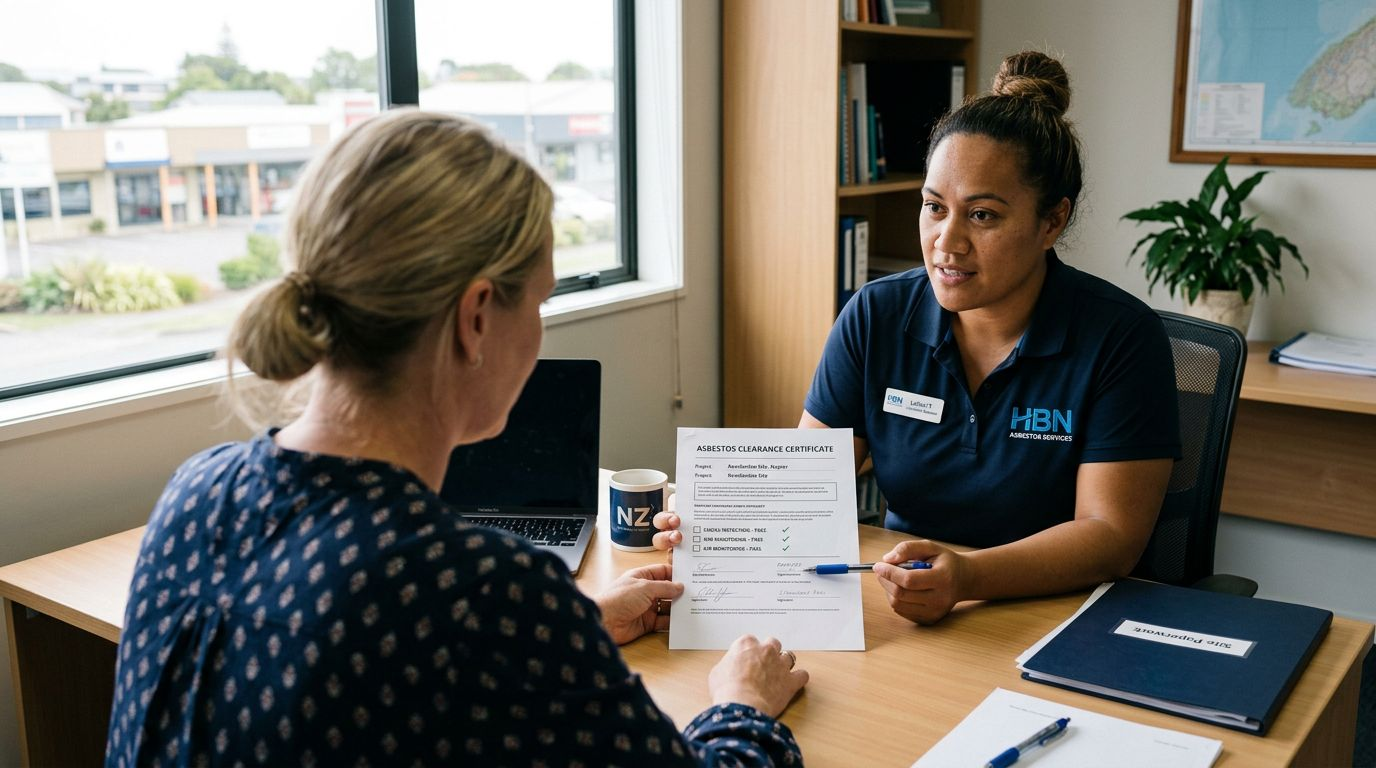
An asbestos clearance certificate is a formal document issued by an independent licensed assessor or a competent person. It confirms that a removal area has been thoroughly cleaned and is safe for reoccupation. Under the Health and Safety at Work (Asbestos) Regulations 2016, a PCBU must obtain this written certificate before anyone else enters the work zone. A PCBU, or Person Conducting a Business or Undertaking, is a legal term that covers property owners, landlords, and business operators who have management or control of a workplace.
The law is very clear on the consequences of skipping this step. According to Regulation 42 of the Health and Safety at Work (Asbestos) Regulations 2016, failing to obtain a clearance certificate can lead to a fine of up to $10,000 for an individual or $50,000 for a business. Beyond the financial risk, the certificate provides the peace of mind that the invisible threat of respirable fibres has been addressed.
The Four-Stage Clearance Process Explained
We follow a standardised four-stage process to ensure nothing is missed. This structured approach is the industry standard in New Zealand for verifying that a site is safe for normal use or demolition. Each stage must be passed before the next one begins, creating a series of safety checks that protect everyone involved.
Stage 1: Preliminary Documentation Review
The process begins with an examination of the removal site and the documentation provided by the removalist. We check the scope of work against the actual site to ensure everything planned for removal has been addressed. We also verify that the site is dry and that all waste has been safely removed from the area.
Stage 2: Thorough Visual Inspection
This is a meticulous search of all surfaces within the removal area. We look into cavities, behind skirting boards, and inside cupboards. The goal is to ensure that no visible asbestos dust or debris remains. If we find even a small amount of residue, the stage is failed, and the removalist must clean the area again. A clearance certificate must be issued before the area can be reoccupied for normal use, demolition, or other activities.
Stage 3: Clearance Air Monitoring
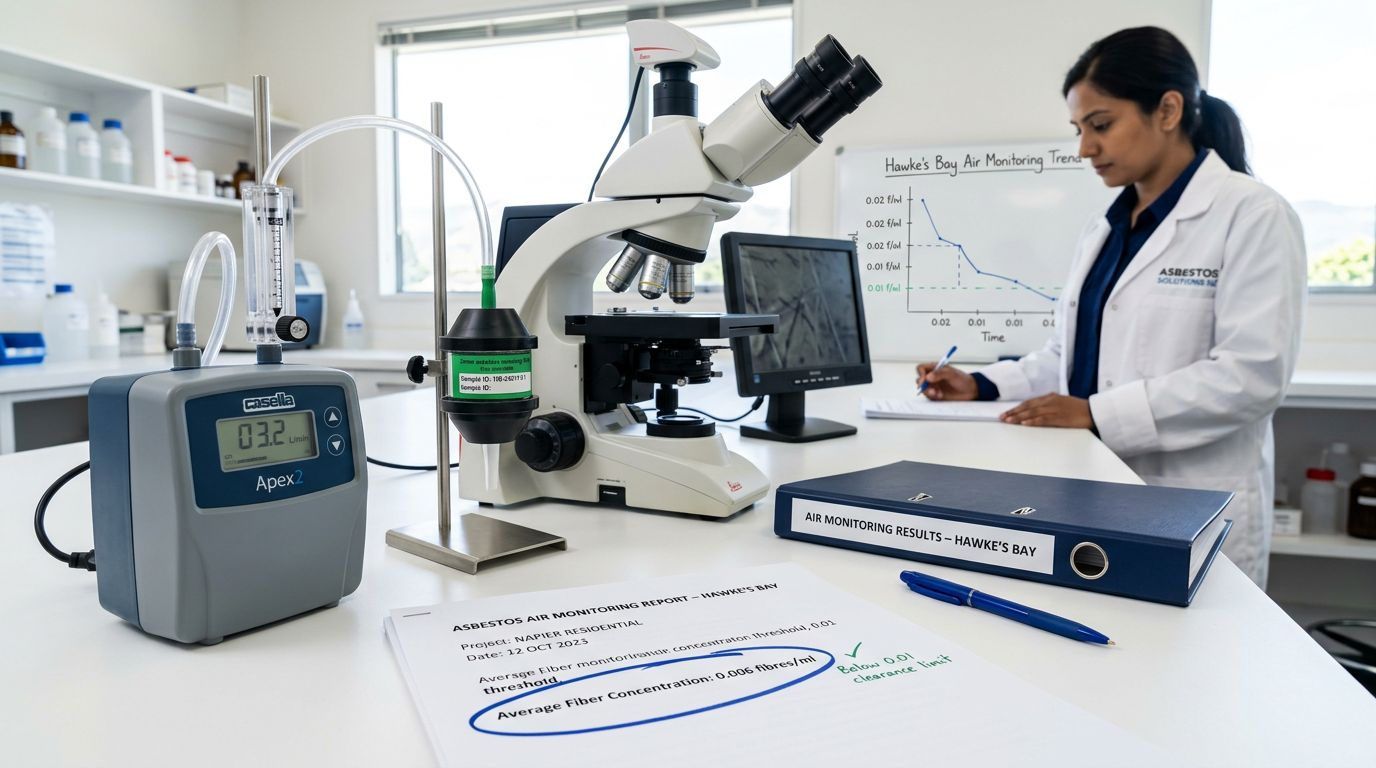
For Class A removal work, and often for Class B, air monitoring is a mandatory requirement. We use specialised equipment to draw air through a filter, which is then analysed under a microscope to count respirable fibres. Airborne fibre levels are measured in fibres per millilitre (fibres/ml), which indicates the concentration of fibres in the air. WorkSafe standards are very strict here. During removal, work must stop if air monitoring shows levels at or above 0.02 fibres/ml. For a clearance certificate to be issued, the air monitoring must show that the respirable asbestos fibre level is at or below 0.01 fibres/ml.
Stage 4: Final Assessment
Once the visual inspection is passed and the air monitoring results are confirmed as safe, we conduct a final assessment. We ensure the containment has been dismantled correctly and the site is left in a tidy state. Only after these four stages are successfully completed do we sign the official clearance certificate.
Why Independence is Essential for Compliance
A common mistake we observe is property owners assuming their removal contractor can sign off their own work. New Zealand regulations require that the clearance certificate be issued by an independent party. This ensures there is no conflict of interest and that the inspection is truly objective. An independent assessor works for you, the property owner, to verify that the contractor has done their job to the required standard.
Using an independent consultancy protects your health and your legal standing. We provide independent Asbestos Clearance Certificates in Hawke’s Bay, Gisborne and Manawatū, giving you a local partner who understands the specific requirements of the New Zealand landscape. Our independence is your guarantee that the safety thresholds have been met without compromise.
Understanding the Costs and Your Responsibilities
Managing asbestos is an investment in the safety of your building and its occupants. We believe in transparent pricing to help you plan your project effectively. Our Asbestos Clearance Certificates start from $299 plus GST, and Asbestos Air Monitoring also starts from $299 plus GST. These costs are a small fraction of the potential fines for non-compliance, and they are incomparable to the value of human health.
For those managing larger projects, you may need to consider where the clearance fits into your wider duties. We recommend reviewing our asbestos compliance roadmap for New Zealand property owners to understand how surveys and management plans work together. We offer a range of related services to help you stay compliant, including Asbestos Testing starting from $210, Management Surveys from $299, and Refurbishment and Demolition Surveys from $349 (all prices exclude GST).
The Safety Thresholds at a Glance
Understanding the numbers helps clarify why the clearance process is so rigorous. The margin for error is incredibly small because even low levels of exposure can lead to disease over time. In New Zealand, the "stop-work" trigger during removal is 0.02 fibres/ml. However, to pass a clearance air test, the level must be less than 0.01 fibres/ml. This stringent standard ensures that the air you breathe when you return to the space is as safe as possible.
Taking these steps is the only way to ensure that your home or workplace is safe. If you are planning removal work or have a project nearing completion, reach out to us to schedule your independent inspection. We are here to help you cross the finish line with confidence, knowing that your property is compliant and, most importantly, safe for everyone who enters.
Book Your Asbestos Clearance Inspection
If your asbestos removal project is complete, you cannot legally reoccupy the area without a clearance certificate.
Delays in getting your clearance can hold up:
- Reoccupation
- Renovations
- Project sign-off
At Asbestos Safe Consultancy, we provide fast, independent asbestos clearance inspections across:
- Napier
- Hastings
- Hawke’s Bay
- Gisborne
- Manawatu
- Taupo
✔ Independent from removal companies (fully WorkSafe compliant)
✔ Fast turnaround to avoid project delays
✔ Clear, professional certification
👉 Call 022 460 7184 today to book your asbestos clearance inspection
👉 Or email: asbestossafeconsultancy@outlook.co.nz