
Asbestos Horror: What Happens When Your NZ Workplace Lacks a Management Plan?
What Happens If Your Workplace Does Not Have an Asbestos Management Plan?
Operating a business in New Zealand comes with a clear set of safety expectations, particularly when it comes to hazardous materials. If you manage a commercial building, a school, or a warehouse built before 2000, asbestos is a reality you must address. Failing to have a formal management plan in place creates significant exposure for your business, your tenants, and your reputation.
Key Takeaways
- Buildings constructed or refurbished before 1 January 2000 are legally presumed to contain asbestos until proven otherwise.
- A PCBU (Person Conducting a Business or Undertaking) must have a written Asbestos Management Plan (AMP) if asbestos is present or likely to be present.
- WorkSafe NZ can issue significant fines, ranging up to $250,000 for businesses that fail to meet these regulations.
- Contractors and tradespeople frequently refuse to work on sites that lack a current asbestos register and management plan.
- Asbestos remains the leading cause of work-related deaths in New Zealand, claiming approximately 220 lives every year.
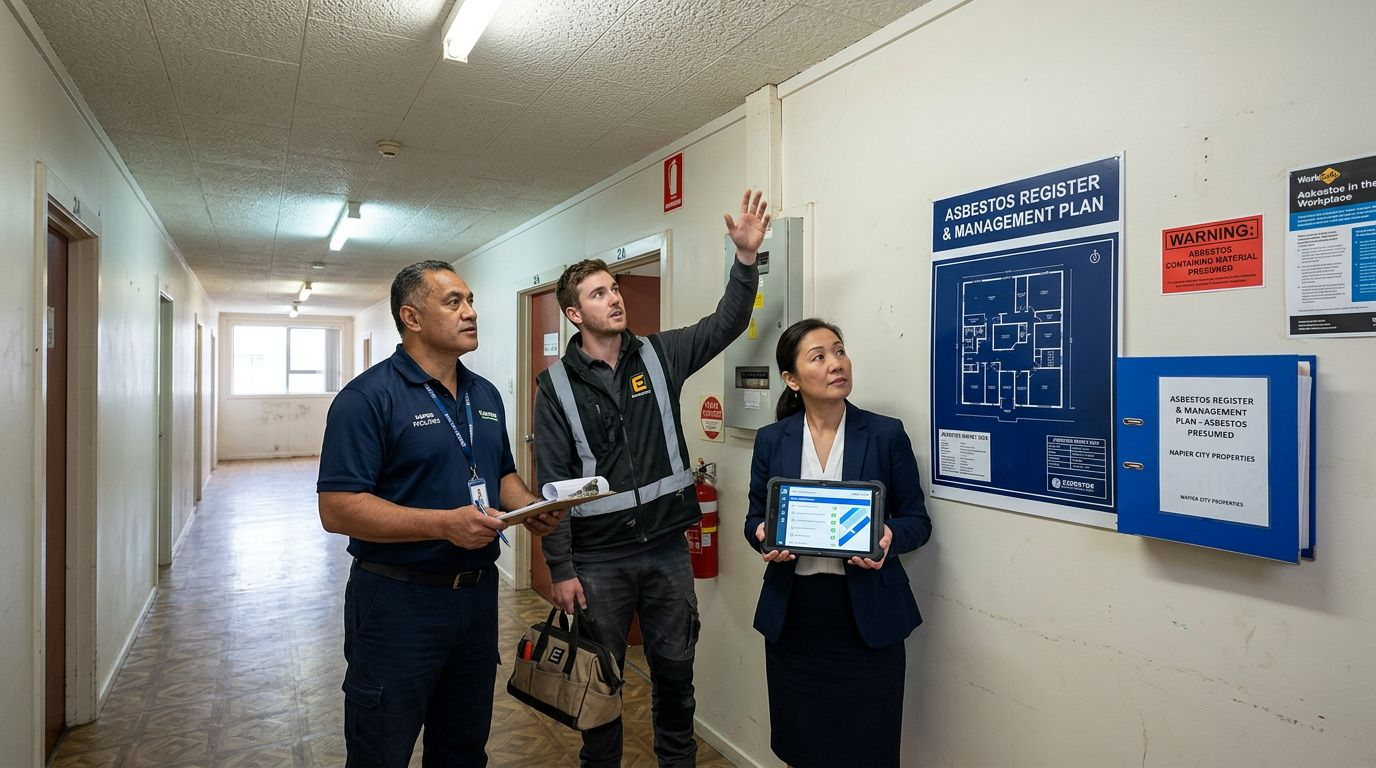
The Legal Reality for Pre-2000 Buildings
The Health and Safety at Work (Asbestos) Regulations 2016 shifted the burden of proof onto property owners and managers. In New Zealand, any workplace built or renovated before 1 January 2000 carries a high probability of containing asbestos. The law requires you to assume asbestos is present unless you have evidence to the contrary. This means "not knowing" is no longer a valid legal position.
If you are a PCBU, you have a mandatory duty to identify asbestos and manage the associated risks. This applies to a wide range of properties across Hawke’s Bay, Gisborne, and the Manawatū, including retail shops in Napier, industrial sheds in Hastings, and rental properties in Palmerston North. A lack of documentation is seen by WorkSafe NZ as a failure to manage a known risk.
You can find more detailed information on your specific obligations through our Asbestos Management Plans service page.
The Difference Between a Survey and a Management Plan
A common misunderstanding in the industry is that a one-off asbestos survey satisfies the law. While a survey identifies the presence of materials, it is only the first step in a broader compliance strategy. An Asbestos Management Plan (AMP) is the active framework that dictates how those materials are handled over time.
A compliant AMP includes a detailed asbestos register, risk ratings for each material, and clear procedures for maintenance and emergencies. It also sets out a schedule for regular reviews. Without this plan, a survey is simply a list of problems without a strategy for solutions. Modern compliance requires active management rather than passive identification.
For those starting from scratch, the first step is often professional asbestos testing to confirm exactly what you are dealing with.
The Cost of Non-Compliance: Fines and Delays
The financial consequences of operating without a plan are immediate and often severe. WorkSafe NZ has the authority to issue improvement or prohibition notices, which can shut down a site instantly. Penalties for serious failures under the asbestos regulations can reach fines of up to $50,000 for individuals and $250,000 or more for businesses.
Beyond government fines, you face operational hurdles. Imagine a plumber in Taupō or an electrician in Gisborne arriving to perform routine maintenance. If they see older vinyl flooring or textured ceilings and you cannot produce a management plan, they have a right to refuse work. This leads to project delays, increased costs, and frustrated tenants. Many insurance providers also scrutinise asbestos management during claims, and a lack of a plan may complicate your cover or lead to a declined payout.
If you are planning significant work, you must also consider asbestos demolition and refurbishment surveys, which are more intrusive and required before any structural changes occur.
Health Risks: Protecting Your Team and Tenants
Asbestos is recognised as New Zealand’s number one workplace killer. Because the fibres are invisible to the naked eye, exposure often goes unnoticed until decades later. When a workplace lacks a management plan, simple tasks like drilling into a wall to run data cables or replacing a ceiling tile can release dangerous dust.
Take a school in Palmerston North or an office block in Napier as an example. Without a plan, a maintenance worker might unknowingly disturb deteriorating asbestos lagging or fire doors. The liability for this exposure rests with the PCBU. An AMP provides the instructions necessary to ensure that anyone working on your property remains safe and informed.
To keep your documentation current and your people safe, the law requires that your plan be reviewed at least every five years. Our asbestos re-inspections service ensures that your register reflects the current state of the building.
Common Misconceptions About Asbestos Duties
Many property owners believe that a small office or a low-risk environment exempts them from these rules. In reality, the Health and Safety at Work Act applies to any space defined as a workplace. Whether you run a boutique law firm in Lower NTT or a large factory in Hastings, the requirement to manage asbestos remains the same.
Another myth is that asbestos is only dangerous if it is being removed. Risk profiles change as building materials age and deteriorate. A vinyl floor that was safe five years ago may now be cracking and releasing fibres. Regular monitoring through a management plan is the only way to track these changes and mitigate risk before an incident occurs.
You can find answers to more specific questions on our asbestos management FAQs page.

How to Establish a Compliant Management Plan
Bringing your workplace into compliance is a straightforward process when handled by experts. We recommend a four-step approach to ensure you are fully protected. First, arrange a management survey and professional testing to identify any asbestos-containing materials. Second, compile this data into a formal asbestos register.
Third, develop a written Asbestos Management Plan that outlines your control measures and emergency procedures. Finally, ensure this plan is accessible to all workers and contractors who enter the site. We provide a range of asbestos guides and templates to help you understand what this documentation should look like.
As an independent consultancy, we provide unbiased advice. We do not remove asbestos, which means our only priority is giving you an accurate assessment of your risks and a clear path to compliance. Whether you are in Hawke’s Bay, Gisborne, Taupō, or the Manawatū, we are here to help you navigate these regulations with confidence.