
Asbestos in Soil: Identifying and Managing a Hidden Contamination Risk
Asbestos in Soil: Managing Hidden Contamination on New Zealand Properties
Disclaimer: This article provides general information regarding asbestos management and does not constitute legal or professional health advice. Always consult a qualified specialist for site-specific requirements and compliance with New Zealand regulations.
Key Takeaways
- Asbestos in soil is a legacy of demolition, storm damage, and historical construction waste.
- New Zealand has specific soil guideline values for different land uses, including residential and commercial.
- Professional soil testing is the only way to identify microscopic fibres that pose a health risk.
- Effective remediation ranges from capping and onsite management to full excavation and disposal.
- Maintaining soil moisture at five percent can reduce airborne fibre release by up to ninety five percent.
Asbestos risk in New Zealand extends beyond ageing roofs, soffits, and vinyl. We often find it lurking in the soil as a legacy of demolition, storm damage, buried construction waste, and factory fill. For property owners, developers, and councils, a building asbestos problem easily transforms into an asbestos contaminated land problem if materials are not identified and managed before demolition or earthworks begin. In our experience, treating soil contamination as a priority during the planning phase is the most effective way to avoid massive unexpected costs later.
Asbestos remains New Zealand’s leading workplace killer, responsible for an estimated 220 deaths each year. While many people associate these deaths with tradespeople working on old buildings, the risk from contaminated land is just as real when dust is disturbed. We provide independent asbestos testing to help you identify these risks early, ensuring your project remains safe and compliant with WorkSafe regulations.
How Asbestos Enters New Zealand Soils
Contamination usually occurs through the degradation of Asbestos Containing Material (ACM). Over decades, asbestos fibres from unsealed cladding or roofing can wash into the soil via rainwater runoff. We also see significant contamination caused by historical water blasting of asbestos roofs, which strips the surface and deposits concentrated amounts of fibres into the garden beds below. However, the most severe cases often stem from poor demolition practices where ACM was crushed, spread, or buried onsite rather than being properly removed.
We have seen this happen frequently on post disaster sites. For example, A real example of buried demolition waste turning into an asbestos contaminated section occurred after Cyclone Gabrielle, where a demolished house was buried onsite, leaving the land unusable for new development due to the high cost of remediation. Asbestos is inert in soil and avoids poisoning groundwater, meaning the primary health risk arises specifically from disturbance that releases fibres into the air. Any asbestos added to soil will stay there forever unless it is physically removed, making it a permanent liability for the landowner.

Understanding New Zealand Soil Guideline Values
To manage this risk, we look to the BRANZ soil guideline values for asbestos in New Zealand workplaces. These guidelines set specific thresholds based on weight for weight (w/w) concentrations. For bonded ACM, which refers to asbestos fibres bound tightly within a matrix like cement, the guideline values are 0.01% w/w for residential land, 0.04% for high density residential, 0.02% for recreational land, and 0.05% for commercial or industrial sites.
The rules become much stricter when dealing with Fibrous Asbestos (FA) and Asbestos Fines (AF). These terms describe asbestos that is easily crumbled or consists of microscopic small fibres that are more likely to become airborne. The guideline value for FA and AF is a tiny 0.001% w/w across all land use categories. Furthermore, New Zealand regulations require that there be no visible asbestos on surface soil at the surface of a site. If you suspect your land contains these materials, the Health and Safety at Work (Asbestos) Regulations 2016 place a duty on you to investigate and manage the risk.
The Risk of Leaving Soil Contamination Unmanaged
Ignoring asbestos in soil allows the problem to grow. Environmental factors like wind and rain can migrate fibres across a site or onto neighbouring properties. A 2025 peer reviewed study of villages around an abandoned asbestos mine found that 12 of 16 residential soil samples (75%) contained chrysotile asbestos. Even more concerning, satellite analysis showed the visible asbestos contaminated area expanded by about 20% between 2006 and 2019. This demonstrates how uncontained waste spreads over time, potentially turning a small hotspot into a site wide contamination issue.
How We Coordinate Asbestos Soil Testing
Testing soil for asbestos is a specialized process that goes far beyond a simple visual check. We coordinate sampling and laboratory analysis using IANZ accredited facilities. These labs use advanced techniques like Polarised Light Microscopy (PLM), Scanning Electron Microscopy (SEM), or Transmission Electron Microscopy (TEM) to determine the presence and form of asbestos. According to SGS New Zealand, they can test samples of made ground, soil, rock, and ballast, with results typically available within three to five days.
We offer asbestos testing in Hawke’s Bay, Gisborne, Taupō and Manawatū and throughout New Zealand. Our testing starts at $210 + GST, which includes sample collection, laboratory analysis, and a full report. For larger sites or complex developments, we may recommend additional samples to map the extent of the contamination. Knowing exactly what is in your soil allows you to plan your remediation budget with confidence rather than guessing.
Remediation Options and Onsite Controls
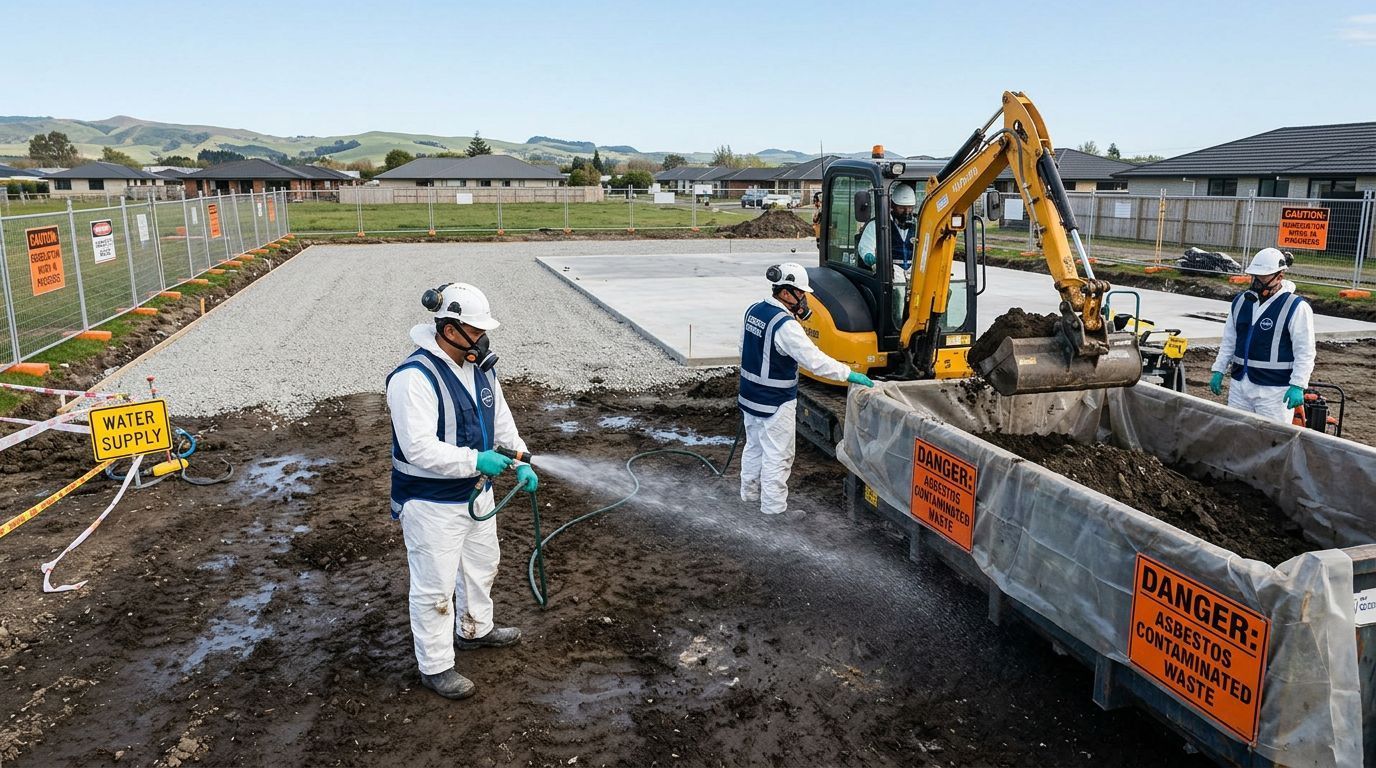
Once contamination is confirmed, you have two primary paths: in situ management or soil removal. In situ management involves capping the contaminated soil with clean fill or a permanent surface like concrete to prevent fibre release. This is often a cost effective solution for commercial sites where the soil will not be disturbed. However, if you are planning earthworks or residential development, excavation and offsite disposal at a licensed landfill may be necessary.
During any soil disturbance, dust control is your best defence. BRANZ cites testing data showing that adding just 5% moisture to contaminated soil can reduce airborne asbestos by 80 to 95%. This simple step of wetting the ground is a critical control measure that we always emphasize. For more detail on these choices, you should read your guide to asbestos removal and remediation options in NZ, which explains the legal requirements for licensed removalists.
Legal Responsibilities and Consultancy Costs
New Zealand law is very clear about who can handle asbestos. Under WorkSafe NZ rules, unlicensed persons may only remove up to 10 square metres of non friable asbestos over the course of a whole project. Any friable asbestos or larger quantities of contaminated soil require a licensed removalist and an independent clearance inspection. We provide the independent oversight you need to ensure the work is done correctly and safely.
Our consultancy pricing is transparent and designed to help you navigate these regulations without hidden costs. Beyond our initial testing starting from $210, we offer Asbestos Management Surveys from $299, Refurbishment and Demolition Surveys from $349, and Asbestos Air Monitoring from $299. If you have completed a soil remediation project, an Asbestos Clearance Certificate starts from $299 and provides the legal proof that the site is safe for occupancy or further construction. All prices exclude GST.
Professional Independence You Can Trust
We pride ourselves on providing 100% impartial advice with no hidden agendas. Because we do not carry out removal work ourselves, our only goal is to give you the facts and the best practical path forward. Our team is BOHS IP402, IP403, IP404, and IP405 qualified, bringing over 10 years of experience from both New Zealand and Australia to your project. Whether you are a homeowner in Napier, a developer in Palmerston North, or a council in Gisborne, we help you ensure that when the house is gone, the asbestos goes with it.