
Asbestos Air Clearance Testing & Monitoring Guide | NZ
Clearing the Air: The Essential Guide to Asbestos Air Clearance Testing
Key Takeaways
- Air monitoring provides the only scientific proof that an area is safe to re-occupy after asbestos removal or disturbance.
- New Zealand regulations mandate a "trace level" of less than 0.01 fibres per millilitre for a successful clearance.
- Independent testing removes conflicts of interest, ensuring your removal contractor is held to the highest safety standards.
- Specific monitoring types, including background and control testing, help manage risks throughout the entire duration of a project.
Managing a building project or property renovation involves a lot of moving parts, but safety remains the most critical priority. When asbestos is part of the equation, the stakes are high because the dangerous fibres are invisible to the naked eye. We often talk to property owners in Hawke’s Bay and Gisborne who feel uncertain about when their site is truly safe to re-enter. This is where professional air monitoring becomes your most valuable tool.
Asbestos air monitoring involves using specialised pumps to draw air through a filter, which is then analysed in an accredited laboratory to count any airborne fibres. It serves as a scientific safeguard, replacing guesswork with data. Whether you are overseeing a commercial demolition in Napier or a residential renovation in Gisborne, understanding the "what" and "why" of this process ensures you stay compliant and, more importantly, keep people safe.
Our team provides comprehensive asbestos air monitoring across NZ to help clients navigate these requirements with confidence. We focus on delivering clear, plain-English results that allow your project to move forward without unnecessary delays.
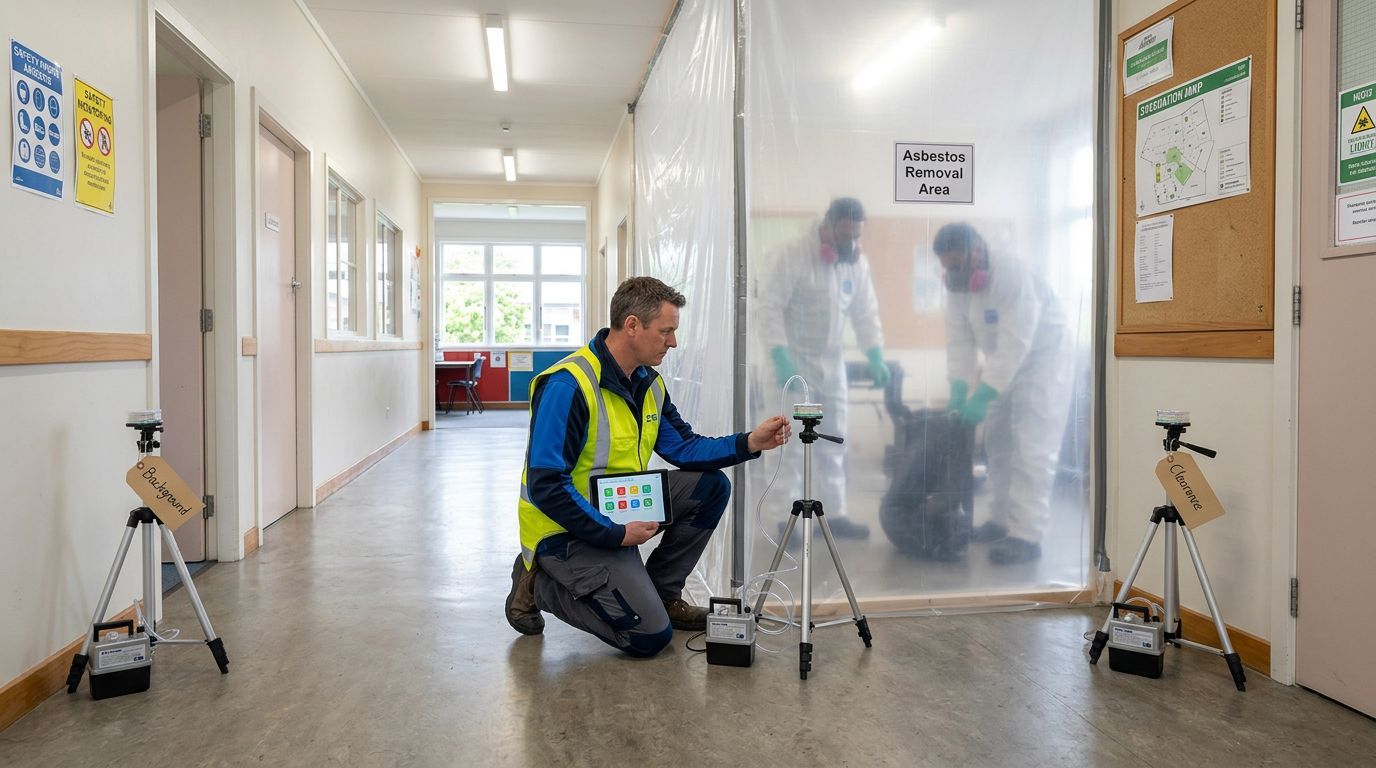
The Three Main Types of Asbestos Air Monitoring
Air monitoring serves different purposes depending on the stage of your project. We categorise these into three distinct phases to ensure every risk is covered.
1. Background Monitoring
We conduct background monitoring before any work begins to establish the baseline fibre levels in the area. This is particularly useful in sensitive environments like schools or hospitals. If a neighbour or tenant raises concerns later, these initial results provide a clear reference point to prove that the work itself did or did not impact the surrounding air quality.
2. Control and Leak Monitoring
During the removal process, static monitors are placed just outside the work enclosure. This acts as a real-time check on the containment measures. If the negative pressure units or plastic barriers fail, control monitoring detects the escape of fibres immediately. This allows the removal team to stop work, fix the issue, and prevent contamination from spreading to the rest of the building.
3. Asbestos Air Clearance Testing
This is the final and most important step. Once the removal is finished and the area has been cleaned, we perform air clearance testing. This test confirms that the air is clean enough for the enclosures to be taken down and for people to return to the space. This specific test is a legal requirement for an independent asbestos clearance certificate after licensed removal work.
Decoding the Numbers: What 0.01 Fibres/ml Actually Means
New Zealand safety standards rely on specific numerical thresholds to define safety. Understanding these numbers helps you appreciate the rigour of the testing process.
The workplace exposure standard in New Zealand is 0.1 fibres per millilitre (f/ml) over an eight-hour period. This represents the absolute maximum concentration a worker should ever be exposed to. However, when we talk about "clearing" a room for the general public or residents, the standard is much stricter. We look for a "trace level" of less than 0.01 f/ml. This is a microscopic amount, roughly equivalent to finding a single grain of sand in a large swimming pool.
If a test result hits 0.02 f/ml during a removal project, WorkSafe regulations require the removalist to stop work immediately. At this level, the incident must be investigated, the area re-cleaned, and the controls improved. Only when the air returns to the 0.01 f/ml threshold can the site be declared safe for re-occupation. We use IANZ-accredited laboratories to ensure these tiny concentrations are measured with absolute precision.
The Legal Requirement for Independence
New Zealand law requires a clear separation between the people removing the asbestos and the people testing the air. A removal contractor signing off on their own work creates a conflict of interest that could compromise safety. An independent assessor works for you, the property owner, to ensure the removalist has done their job correctly.
We maintain total independence by focusing solely on consultancy and testing. We do not perform removals, which means our only goal is to provide an honest, accurate assessment of your site. Our BOHS-qualified consultants act as your technical eyes and ears on the ground. This independence is especially important for PCBUs (Persons Conducting a Business or Undertaking), as failing to obtain a proper clearance certificate can result in fines of up to $50,000 for a business.
For a detailed look at all our compliance options, you can view our full range of independent asbestos consultancy services.
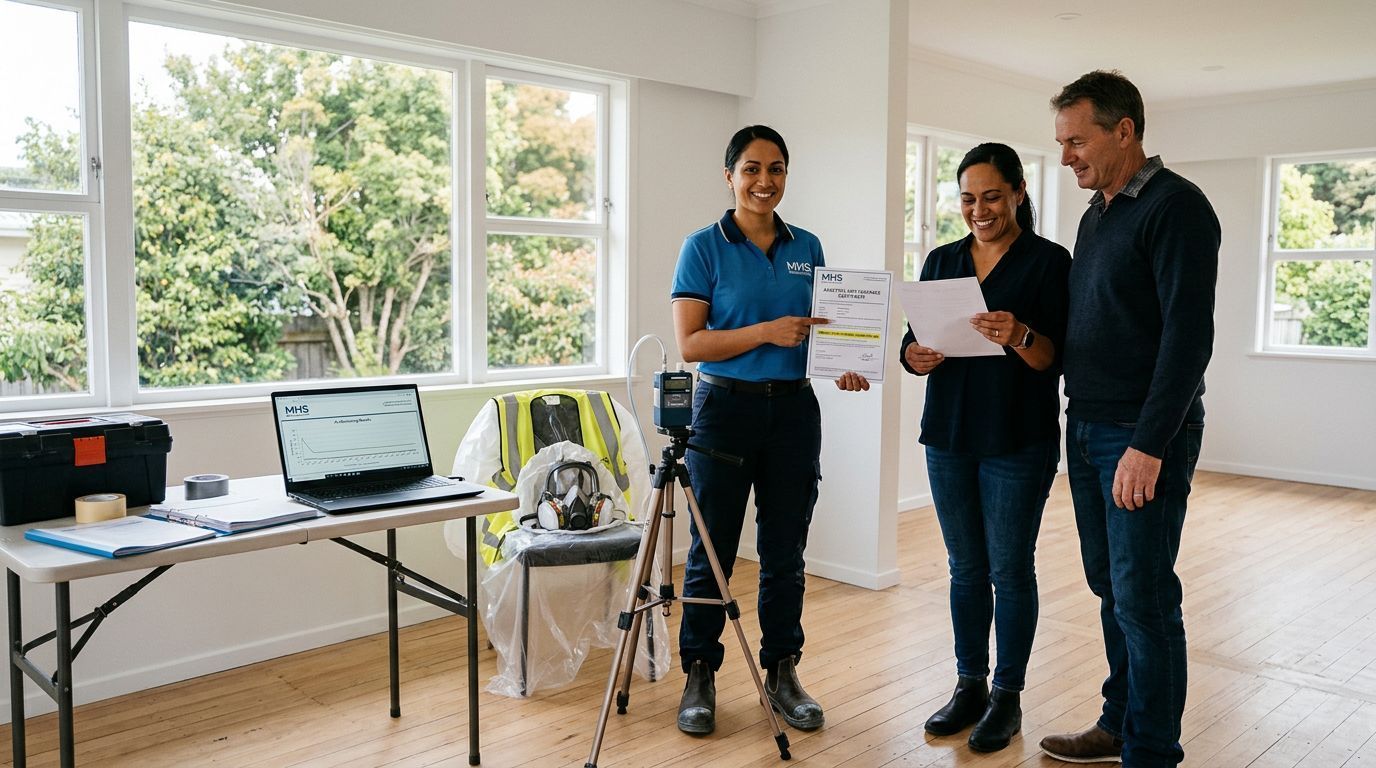
The Step-by-Step Clearance Process
A clearance test is more than just turning on a pump. It follows a strict protocol to ensure no hidden dust is left behind.
First, we perform a thorough visual inspection to confirm all visible asbestos waste has been removed and the area is clean. Once the visual check passes, we set up flow-calibrated pumps at head height, usually between one and two metres off the ground. We then use "disturbance testing," which involves agitating the air within the enclosure to lift any settled dust. This ensures that if there are fibres present, they are captured by our filters rather than settling back down once we leave.
The samples are then rushed to a lab for Phase Contrast Microscopy (PCM) analysis. If the results come back below the 0.01 f/ml limit, we issue the clearance certificate. If the area fails, the removalist must clean the space again, and we repeat the entire testing process. This rigorous cycle continues until the site is proven safe.
Practical Scenarios in Hawke’s Bay and Gisborne
Local geography and building types often dictate the need for specific monitoring strategies. Take a developer refurbishing a heritage building in the Gisborne CBD, for example. Because these buildings are often close to public footpaths and other businesses, background and control monitoring are essential to prevent public complaints and satisfy council requirements.
In residential cases, such as storm-damaged homes in the Tararua district or Hawke’s Bay, insurance companies often require independent air clearance testing before they will allow homeowners to return. Even when the law does not strictly mandate air monitoring for small Class B jobs, many of our clients choose "reassurance monitoring" to provide peace of mind for their families or employees. Investing in a test that starts from $299 + GST is a small price to pay compared to the long-term health risks of asbestos exposure.
Frequently Asked Questions
Do I need air monitoring for every asbestos job?
Air monitoring is mandatory for all Class A (friable) asbestos removal. For Class B (non-friable) work, it is highly recommended if there is any uncertainty about fibre levels or if the work is being done in a sensitive environment like a school or office.
How long does it take to get results?
We typically provide lab results within 24 hours of the samples being taken. We understand that project timelines are tight, and we work quickly to ensure you aren't left waiting for clearance.
Can my builder do the air test?
Testing must be carried out by a qualified and independent asbestos assessor. A builder or removalist does not have the equipment, the accreditation, or the legal independence required to issue a clearance certificate.
Who keeps the records of these tests?
Under New Zealand regulations, records of air monitoring and clearance certificates must be kept for several years. We maintain digital copies of all our reports to ensure you always have access to your compliance history.
Ensuring your property is safe requires a professional, data-driven approach. By choosing independent air clearance testing, you protect your health, your liability, and the people who live and work in your buildings. If you are planning work that involves asbestos, contact us today to discuss a monitoring plan tailored to your site.