
Inside the Asbestos Testing Laboratory: How Your Samples Are Analysed for Safety
Inside the Asbestos Testing Laboratory: How Your Samples Are Analysed for Safety
Key Takeaways
- Accredited laboratories use Polarised Light Microscopy (PLM) to identify specific asbestos types and estimate their concentration in building materials.
- Air monitoring samples undergo Phase Contrast Microscopy (PCM) to count airborne fibres and ensure spaces are safe for re-occupation.
- IANZ accreditation serves as the gold standard for technical competence, ensuring results are legally defensible and recognised by WorkSafe NZ.
- Strict chain-of-custody protocols track every sample from the moment of collection until the final report is issued to the property owner.
When a consultant takes a small piece of your ceiling or a fragment of vinyl flooring, that sample begins a highly regulated journey. For property owners and managers in Hawke’s Bay, Gisborne, and across the central North Island, the results of this analysis dictate the next steps for safety and compliance. Understanding what happens behind the laboratory doors provides clarity on why professional testing remains the only reliable way to manage asbestos risks.
We ensure that every sample collected during our inspections reaches a facility capable of providing absolute certainty. The laboratory environment is a controlled space where science replaces guesswork, providing the data required to protect your workers, tenants, and family.
The Journey from Site to Lab: Maintaining the Chain of Custody
The process starts with a secure chain of custody. Every sample is double-bagged on-site, labelled with a unique identifier, and logged into a tracking system. This rigour ensures that a sample taken from a shop in Taupō is never confused with one from a warehouse in Napier. When the laboratory receives these items, technicians verify the documentation and check the integrity of the packaging.
Independence remains a fundamental requirement for unbiased safety reporting. By using independent, third-party laboratories, we provide results free from the conflict of interest that sometimes occurs when removal contractors perform their own testing. This separation ensures that the laboratory’s only priority is the accurate identification of hazardous materials.
Professional consultants follow strict protocols to ensure samples are representative of the material being tested. You can learn more about how we safely collect these materials on our asbestos testing service page.
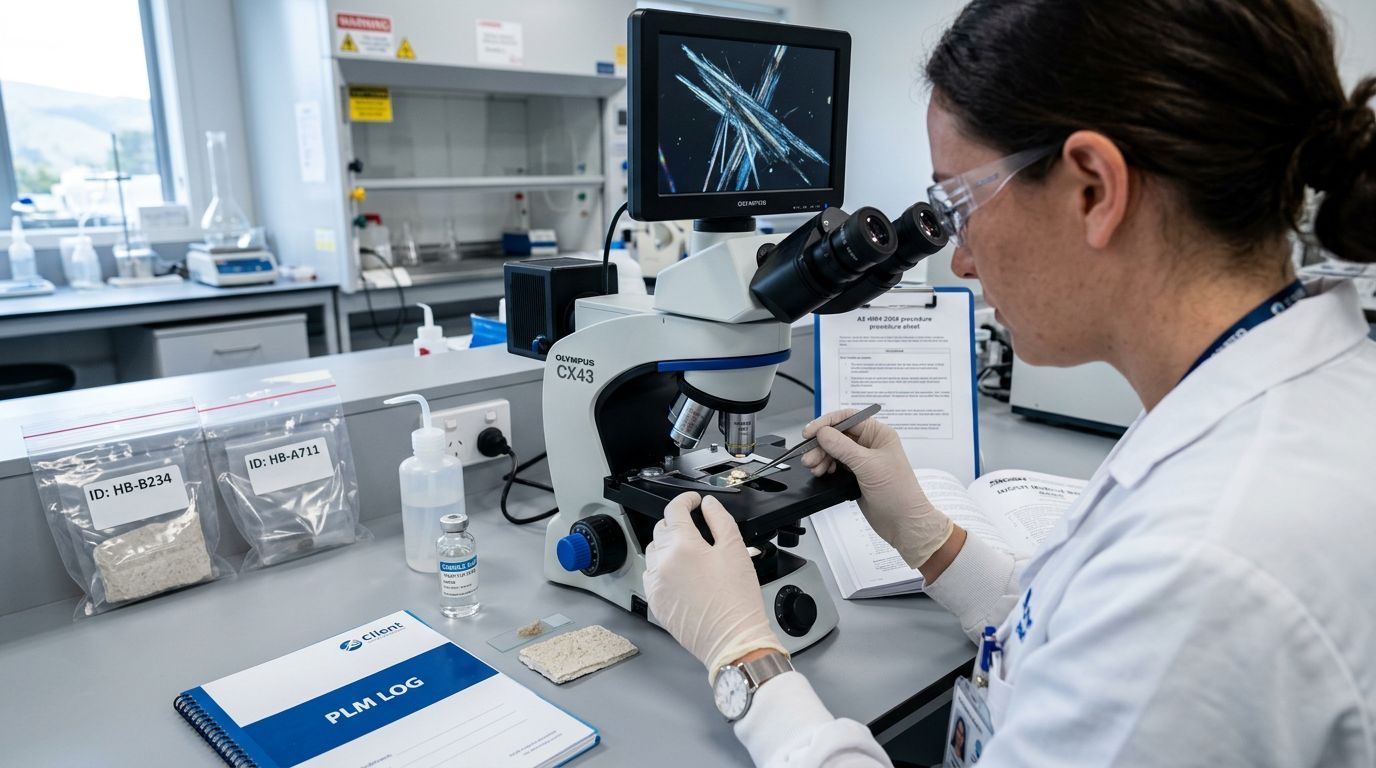
How Bulk Samples Are Analysed Using PLM
Bulk building materials, such as fibre cement sheets or textured plasters, undergo analysis via Polarised Light Microscopy (PLM). This method allows analysts to identify the specific mineral properties of asbestos fibres. Technicians prepare the sample by placing it under a stereo microscope to search for suspicious fibres, which are then teased out and mounted on a slide with specific refractive index liquids.
The analyst uses the PLM to observe how the fibres interact with light. Different types of asbestos, such as Chrysotile (white), Amosite (brown), and Crocidolite (blue), exhibit unique optical characteristics. According to NIOSH Method 9002, this approach provides a qualitative identification and a semi-quantitative estimation of asbestos content, often detecting concentrations well below 1%.
In New Zealand, reputable laboratories commonly use the AS 4964:2004 standard. This method ensures that the qualitative identification of asbestos in bulk samples meets the highest international benchmarks for accuracy.
Air Monitoring and Fibre Counting
While bulk testing identifies what is in a material, air monitoring determines what is in the air people breathe. During and after asbestos removal, air pumps pull a specific volume of air through a fine filter. These filters are then sent to the laboratory for Phase Contrast Microscopy (PCM) analysis.
The laboratory technician clears the filter to make it transparent and counts the fibres visible through the microscope. Following NIOSH Method 7400, analysts count fibres longer than 5 micrometres with a specific length-to-width ratio. This data is used to calculate the fibre concentration in the air, expressed as fibres per millilitre (f/ml).
This quantitative result is essential for issuing clearance certificates. For a detailed look at how these air samples are collected on-site, visit our page on asbestos air monitoring.
Safety and Precision Inside the Laboratory
The same safety principles applied to a construction site are magnified inside the laboratory. Asbestos handling occurs within local exhaust ventilation systems, such as fume hoods or HEPA-filtered enclosures. These systems maintain a face velocity of 0.4 to 0.6 metres per second to prevent any airborne fibres from escaping the work area. Technicians wear appropriate personal protective equipment (PPE) and follow strict decontamination procedures to prevent cross-contamination between samples.
Contamination control is vital. Even a tiny amount of cross-contamination could lead to a false positive, resulting in unnecessary and expensive removal costs for a property owner. Laboratory environments are designed to be easy to clean, with non-porous surfaces and negative pressure zones that keep hazardous particles contained.
Why IANZ Accreditation Is Non-Negotiable
International Accreditation New Zealand (IANZ) provides the official recognition that a laboratory is competent to perform specific tests. IANZ accreditation is based on ISO/IEC 17025, the international standard for testing and calibration laboratories. This accreditation confirms that the lab has the right equipment, qualified staff, and robust quality systems in place.
Under the Health and Safety at Work (Asbestos) Regulations 2016, WorkSafe NZ requires that asbestos analysis be carried out by a competent person. While WorkSafe allows laboratories a 12-month window to obtain accreditation, using a fully IANZ-accredited facility provides the highest level of legal protection. Results from accredited labs are the only ones reliably accepted by local councils, WorkSafe, and the courts.
For a broader perspective on how the lab fits into the entire testing lifecycle, you can read our guide on the full spectrum of asbestos testing.
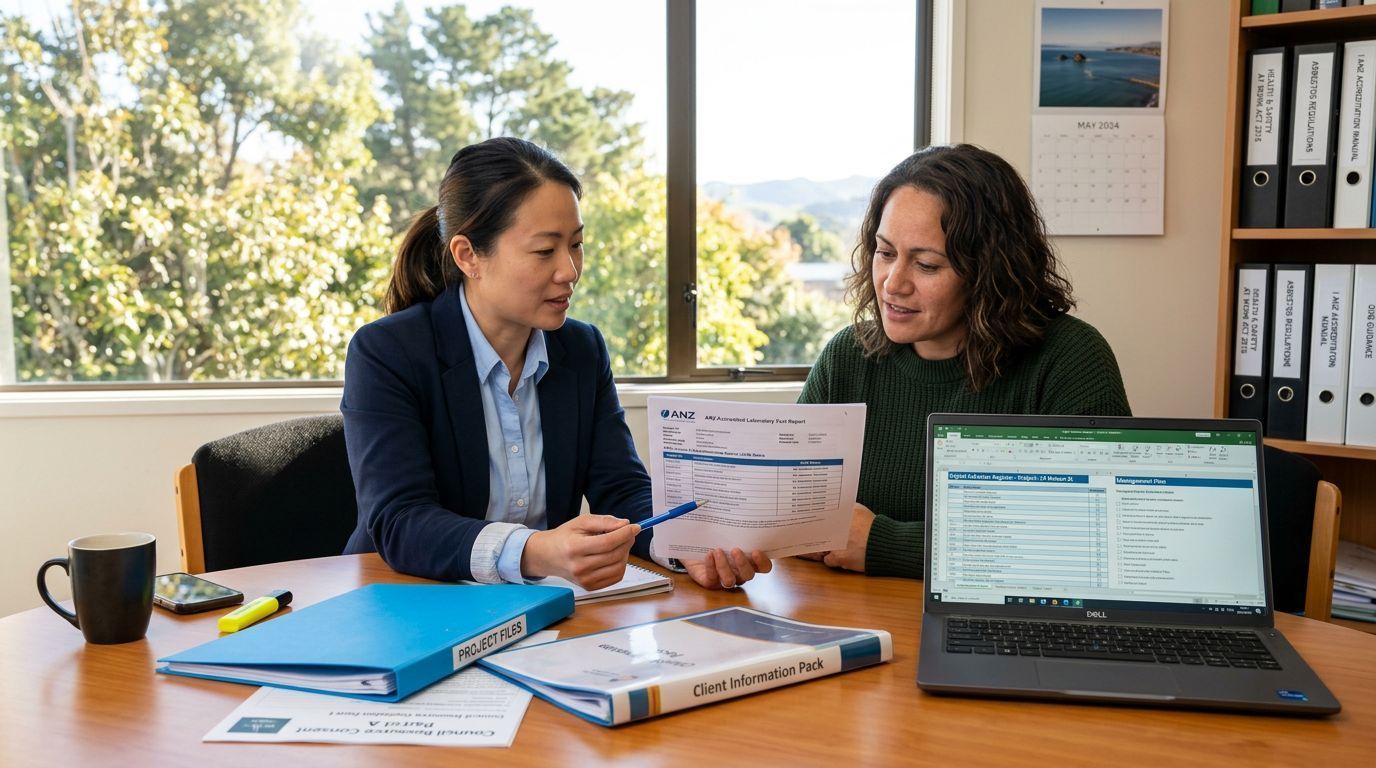
Turning Data into Compliance Decisions
The final output from the laboratory is a technical report, but its value lies in how that data is interpreted. A report stating "No Asbestos Detected" provides the green light for renovations to proceed. Conversely, a positive result for Asbestos-Containing Material (ACM) requires the property owner to update their asbestos register and management plan.
Asbestos remains the leading cause of work-related disease deaths in New Zealand, with approximately 220 people dying each year from related illnesses. The accuracy of a laboratory report is quite literally a matter of life and death. Whether you are a landlord in Lower Hutt or a developer in Gisborne, the certainty provided by an accredited laboratory allows you to make informed decisions that protect your people and your business.
Choosing the Right Partner for Testing
When selecting an asbestos consultancy, always ask about their laboratory partners. A trustworthy provider will openly confirm they use IANZ-accredited facilities and follow recognised methods like PLM and PCM. They should provide clear, plain-English reports that translate complex microscopy results into actionable advice.
We pride ourselves on providing fast, independent, and accurate results across the Hawke’s Bay and surrounding regions. By combining expert on-site sampling with meticulous laboratory analysis, we ensure your property remains safe and compliant with all New Zealand regulations.