
Demolition Dangers: Why Asbestos Surveys Are Non-Negotiable for Safety & Compliance
The Dangers of Demolition: Why an Asbestos Survey is Non-Negotiable
Key Takeaways
- Demolition represents the highest risk for uncontrolled asbestos fibre release due to the destructive nature of the work.
- New Zealand law mandates that all asbestos be identified and removed, as far as reasonably practicable, before demolition begins.
- A demolition survey is significantly more intrusive than a standard management survey, involving destructive access to hidden cavities.
- Skipping a survey leads to severe consequences, including site contamination, legal prosecution, and long-term health risks for workers.
- Independent consultancy ensures survey results remain objective and free from the conflicts of interest found in removal companies.
Demolition is a high-stakes environment where the margin for error is slim. When a building is pulled apart, crushed, or pulverised, every material inside it is disturbed. If that building was constructed or refurbished before 1 January 2000, there is a high probability that it contains asbestos-containing materials (ACMs). Without a comprehensive plan, these materials turn into airborne hazards in seconds.
We see many projects in Hawke’s Bay and Gisborne where the excitement of a new development overshadows the necessary groundwork. However, the reality of modern construction is that safety and compliance must lead the way. Identifying risks before the first hammer swings is the only way to protect your team, your budget, and your reputation.
The Destructive Reality of Demolition Work
Demolition is inherently violent to a building's structure. While routine maintenance might disturb a single panel, demolition shatters and crushes materials, releasing microscopic fibres into the air. These fibres are often invisible to the naked eye but pose the greatest risk when inhaled. Research indicates that demolition workers face significant risks because asbestos-containing materials are frequently crushed or cut during the process.
Consider a developer in Napier planning to clear an old commercial site. If they rely on a basic visual check, they might miss the asbestos insulation tucked behind a double-brick wall or the bitumen adhesive under a layer of concrete. Once the excavators move in, those hidden materials become a widespread contamination issue. The cost of cleaning up a contaminated site is many times higher than the cost of a controlled, pre-demolition removal.
Why Management Surveys Are Not Enough
Many property owners believe a standard management survey provides enough information for a demolition project. This is a common misconception that leads to dangerous oversights. A management survey is designed for buildings in normal occupation. It is largely visual and focuses on materials that might be disturbed during day-to-day use.
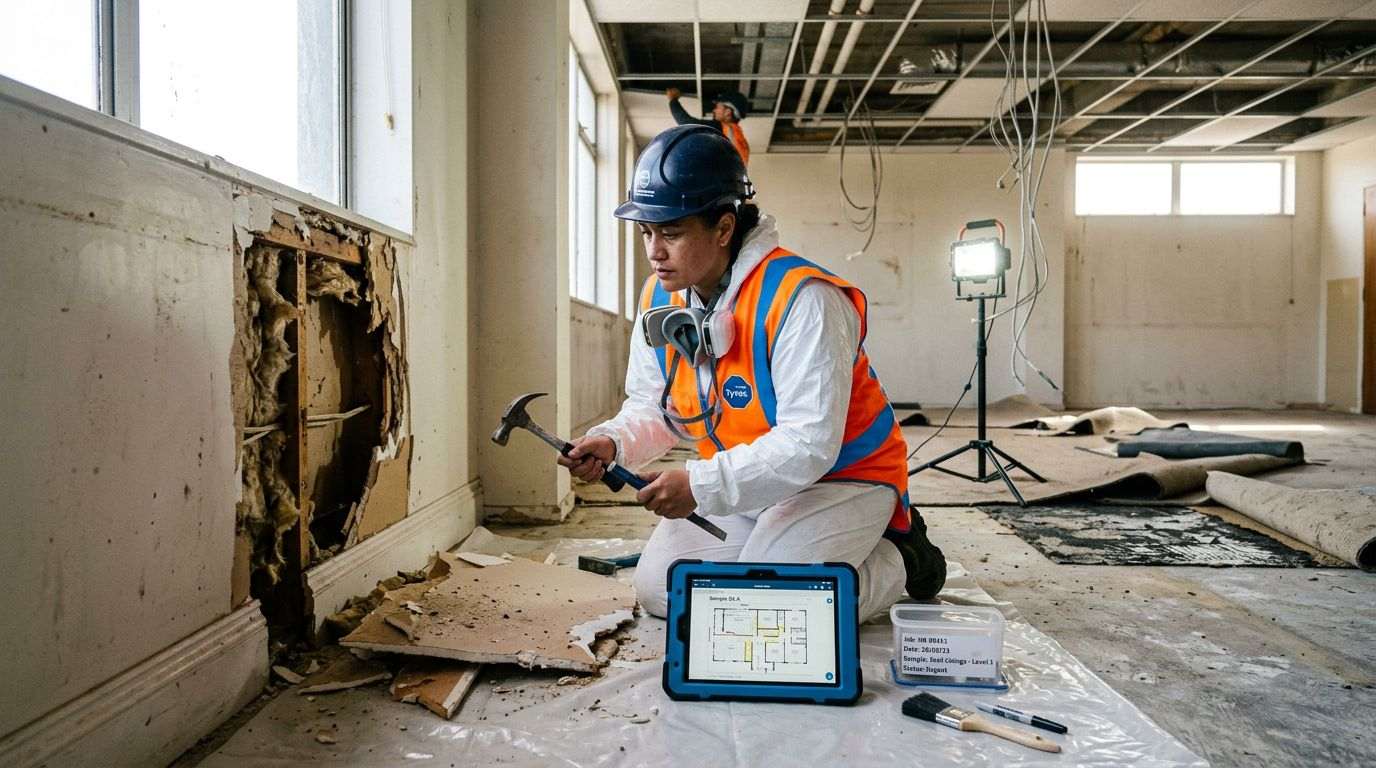
A demolition survey is a different beast entirely. As outlined in the HSG264 guidance, these surveys are fully intrusive and involve destructive inspection. Our surveyors must lift floor coverings, break into wall cavities, and access plant rooms that are usually sealed off. The goal is to find every trace of asbestos so it can be removed before the main demolition crew arrives on site. You can find more detail on this process in our NZ guide to refurbishment and demolition surveys.
Your Legal Obligations Under NZ Law
In New Zealand, the Health and Safety at Work (Asbestos) Regulations 2016 set out clear duties for a Person Conducting a Business or Undertaking (PCBU). If you are in charge of a demolition project, you have a legal mandate to identify asbestos risks before work begins. The law requires that all ACMs be removed, as far as reasonably practicable, prior to demolition.
WorkSafe New Zealand is very clear on this point: buildings built or refurbished before 2000 are likely to contain asbestos. Failing to commission a survey from a competent person is a breach of these regulations. Councils and building consent authorities across the Tararua and Manawatū regions increasingly require these survey reports as a condition of granting demolition or building consents.
The High Cost of Skipping a Survey
The consequences of a "wait and see" approach are almost always negative. We have seen instances where a project is halted mid-way because a contractor discovers a suspicious material. This leads to immediate stop-work notices, emergency testing fees, and a site that must be treated as a hazardous zone until cleared. The delays to the construction programme can be devastating for a project's bottom line.
Beyond the financial impact, the health risks are permanent. Asbestos-related diseases like mesothelioma and asbestosis often have latency periods of 20 to 50 years. A worker exposed on a site in Gisborne today may not show symptoms for decades. International data shows that construction and demolition trades feature heavily in mesothelioma statistics, highlighting the vital importance of proper identification and control.
The Workflow for a Successful Demolition
To keep a project on track, we recommend a specific sequence of events. This ensures that safety is integrated into the project timeline rather than being treated as an afterthought.
The process begins with early engagement. You should contact an independent asbestos surveyor during the planning phase, well before you lodge your consents. We conduct a fully intrusive survey while the building is unoccupied, allowing us to access every area without restriction. Our reports are written in plain English, providing clear guidance that your demolition contractor can use to get accurate quotes for removal.
Once the survey is complete, the identified asbestos must be removed by a licensed professional. Following the removal, an independent clearance certificate is issued. Only then should the final demolition proceed. This structured approach eliminates surprises and ensures everyone on site is working in a safe environment. For a broader look at how these audits fit into your project, you can view our overview of asbestos surveying.

The Importance of Independent Advice
Independence is a cornerstone of our consultancy. We do not perform asbestos removal, which means we have no financial interest in finding more asbestos than is actually present. Our role is to provide an accurate, evidence-based assessment that protects you and your workers. We use IANZ-accredited laboratories for all sampling, ensuring that our results meet the highest standards of accuracy.
Whether you are a landlord in Hastings or a commercial manager in Palmerston North, you need a partner who understands the local building landscape and the specific requirements of New Zealand’s regulations. A proper asbestos demolition survey is the only way to ensure your project starts on a safe and compliant footing. By identifying the risks early, you turn a potential disaster into a managed process.